
Close Menu
  • Featured
    • News
    • Consumption
    • Environment
    • Industry
    • Opinion
    • Policy
    • Production
    • Storage
    • Transmission
  • About Us
  • Advertise
  • Contact Us

Subscribe to Our Newsletter

News, investigations, and analysis — our top stories every morning to start your day right.

Trending
discover what green energy is and understand its importance for a sustainable future. learn how renewable sources can reduce environmental impact and promote clean living.
What is green energy and why it’s important
explore how artificial intelligence is transforming energy management by optimizing efficiency, reducing costs, and promoting sustainable solutions.
The influence of artificial intelligence on energy management
discover the advantages and disadvantages of hydroelectric power, exploring its impact on the environment, energy efficiency, and sustainability.
Exploring the pros and cons of hydroelectric power
Facebook X (Twitter) LinkedIn YouTube TikTok
Energy Reporters
Facebook X (Twitter) RSS
Subscribe
  • Featured
  • News
    Illustration of Abu Dhabi National Oil Company's $11 billion financing deal for future gas production projects.

    ADNOC Secures $11 Billion for Gas Expansion, Transforming Energy Future and Boosting Local Economies

    12/19/2025
    Illustration of Energy Transfer LP's Lake Charles LNG project suspension and strategic shift to pipeline infrastructure.

    Energy Transfer Suspends Lake Charles LNG Project, Sparking Concerns Over Job Losses and Future Energy Solutions

    12/19/2025
    Illustration of a U.S. judge blocking Michigan's attempt to shut down Enbridge's Line 5 pipeline.

    Judge Blocks Michigan’s Effort to Shut Down Enbridge’s Line 5 Pipeline, Sparking Environmental and Economic Debate

    12/18/2025
    Illustration of a Venezuelan oil tanker under U.S. sanctions and its impact on the oil industry.

    Venezuela’s Oil Industry Faces Turmoil as Tanker Seizure Prompts Calls for Contract Revisions and Discounts

    12/17/2025
    Illustration of a woman standing in a snow-covered street in Manhattan during a cold snap.

    US Energy Emergency Declared as Northeast Cold Snap Threatens Homes, Businesses, and Critical Infrastructure

    12/16/2025
  • Use
    learn step-by-step how to conduct an energy audit for your home to identify energy-saving opportunities and reduce utility bills effectively.

    How to conduct an energy audit for your home

    05/19/2026
    explore how energy consumption contributes to climate change and discover strategies to reduce its environmental impact for a sustainable future.

    The impact of energy consumption on climate change

    05/12/2026
    discover essential tips for choosing the best energy provider to save money, ensure reliable service, and find the right plan for your needs.

    Tips for choosing the best energy provider

    05/05/2026
    discover why energy efficiency is crucial for businesses in 2026, helping reduce costs, improve sustainability, and boost competitive advantage.

    Why energy efficiency matters for businesses in 2026

    03/24/2026
    discover easy and effective tips to lower your energy bills with simple changes at home. save money and energy effortlessly starting today.

    How to reduce your energy bills with simple changes

    03/10/2026
  • Climate
    discover what green energy is and understand its importance for a sustainable future. learn how renewable sources can reduce environmental impact and promote clean living.

    What is green energy and why it’s important

    06/09/2026
    discover the environmental benefits of switching to clean energy, including reduced carbon emissions, improved air quality, and a sustainable future for our planet.

    The environmental benefits of switching to clean energy

    04/21/2026
    Illustration of a radiative engine harnessing energy from the night sky using a Stirling engine.

    Night Sky Radiative Engine Sparks New Era of Clean Energy, Transforming How We Harness Power After Dark

    11/25/2025
    Illustration of offshore oil and gas platforms as renewable energy gains prominence in global energy investments.

    HSBC Predicts Significant Decline in Oil and Gas Deals, Shifting Future Energy Landscape and Economic Dynamics

    11/07/2025
    Illustration of Janta Power's innovative three-dimensional solar tower system in a renewable energy setting.

    Janta Power’s Innovative 3D Solar Towers Transform Energy Landscape, Boosting Electricity Generation by 50% for Communities

    10/31/2025
  • Industry
    A bunch of black and white objects with a green arrow above them

    The Ongoing Bribery Case Against Hithium’s Chairman Wu Zuyu Highlights the Stakes for Battery Investors

    02/22/2026
    Illustration of Ford's strategic shift from electric vehicles to gas and hybrid models.

    Ford Reveals $19.5 Billion Charge as EV Strategy Unravels, Impacting Jobs and Future Mobility Choices

    12/17/2025
    Illustration of U.S. energy firms reducing operational oil and gas rigs amidst fluctuating market conditions.

    US Drillers Cut Oil and Gas Rigs Again, Exposing Potential Economic and Environmental Impacts on Local Communities

    12/13/2025
    Illustration of Nador West Med port in Morocco.

    Morocco Moves Closer to $1 Billion LNG Hub, Promising Major Energy Shift and Economic Growth

    12/10/2025
    Illustration of Chevron's Gorgon Stage 3 development project off Western Australia's northwest coast.

    Chevron’s Gorgon LNG Project Secures $2 Billion Investment, Reshaping Energy Landscape and Boosting Local Economy

    12/07/2025
  • Opinion
    lighted city skyline at night

    Korean Companies Are Losing Ground to China: Why Governance Failures at Conglomerates Like Young Poong Group Matter More Than Ever

    03/22/2026

    Pulling back the curtain on Turkey’s natural gas strategy

    09/01/2020

    How West Africa can expand power supply and meet climate goals

    06/15/2020

    Review: Oil and the Great Powers: Britain and Germany, 1914 to 1945

    06/09/2020

    Eastern Mediterranean gas: testing the field

    05/27/2020
  • Policy
    explore how artificial intelligence is transforming energy management by optimizing efficiency, reducing costs, and promoting sustainable solutions.

    The influence of artificial intelligence on energy management

    06/02/2026
    explore how government policies are influencing the energy sector, driving innovation, sustainability, and market dynamics for a cleaner future.

    How government policies are shaping the energy sector

    04/14/2026
    discover the essentials of smart energy management, including how innovative technologies optimize energy use, reduce costs, and promote sustainability for homes and businesses.

    What you need to know about smart energy management

    02/24/2026
    Illustration of the Trump administration's delay in finalizing 2026 biofuel quotas amid oil and agricultural sector tensions.

    Trump Administration Faces Delays in Finalizing 2026 Biofuel Quotas, Raising Questions About Future Energy Policies

    12/14/2025
    Illustration of the U.S. House of Representatives passing a bill to expedite federal permitting for interstate natural gas pipelines.

    US House Bill Speeds Up Natural Gas Pipeline Permits, Promising Faster Energy Access and Economic Growth

    12/13/2025
  • Output
    discover the advantages and disadvantages of hydroelectric power, exploring its impact on the environment, energy efficiency, and sustainability.

    Exploring the pros and cons of hydroelectric power

    05/26/2026
    explore the rise of geothermal energy, its growing importance in sustainable power, and the potential it holds for a cleaner energy future.

    The rise of geothermal energy and its potential

    03/31/2026
    explore the role of nuclear energy in the global power mix, its benefits, challenges, and impact on sustainable energy development worldwide.

    The role of nuclear energy in the global power mix

    03/03/2026
    explore the future of wind energy and discover upcoming trends, innovations, and what to expect in this rapidly evolving renewable energy sector.

    The future of wind energy: what to expect

    02/03/2026

    GWO Certification as a Practical Baseline for Safer Wind Work

    01/22/2026
  • Storage
    explore the latest innovations in battery technology transforming energy storage solutions, enhancing efficiency, capacity, and sustainability for a cleaner future.

    Innovations in battery technology for energy storage

    03/17/2026
    Illustration of Venezuela's oil storage facilities nearing maximum capacity amid U.S. sanctions.

    Venezuela Faces Oil Storage Crisis as Tanker Restrictions Expose Vulnerabilities in Energy Infrastructure and Economy

    12/18/2025
    time lapse photography of square containers at night

    ‘Mega Batteries’ are Powering the Future of Energy Consumption

    10/23/2025
    Illustration of a gravity-based energy storage system integrated into a skyscraper, utilizing renewable energy sources.

    Gravity Battery Innovation Transforms Skyscrapers into Renewable Energy Storage, Revealing New Possibilities for Urban Sustainability

    10/18/2025
    Illustration of a groundbreaking iron-based catalyst developed for affordable hydrogen storage and release.

    “They Just Beat Platinum With Rust”: Japan’s New Iron Catalyst Could Make Hydrogen Power Cheap Enough to Change Everything

    10/11/2025
  • Grid
    explore the fundamentals of energy grids and their modernization, including innovations, smart technologies, and the future of efficient power distribution.

    Understanding energy grids and their modernization

    04/28/2026
    Illustration of Ovintiv and Pembina's collaboration on LNG export from the Cedar LNG facility.

    Ovintiv Agreement for Cedar LNG Capacity Sparks New Era in North American Energy Collaboration and Innovation

    12/16/2025
    Illustration of Star Catcher Industries' power beaming technology at NASA's Kennedy Space Center.

    Star Catcher Achieves Breakthrough, Sets New 1.1-kW Power Beaming Record, Transforming Future Energy Solutions

    11/25/2025
    Illustration of U.S. LNG exports navigating global market challenges and expanding into Asian regions amidst rising competition.

    US LNG Export Dominance Faces Challenge as Sellers Explore New Markets Beyond Europe’s Energy Demand

    11/23/2025
    Illustration of the race to develop new pipelines in response to California refinery closures and rising fuel prices.

    California Refinery Closures Drive Urgent Pipeline Race, Transforming Energy Supply Dynamics on the West Coast

    11/19/2025
Energy Reporters

The most dangerous nuclear power plant

Eirwen WilliamsEirwen Williams08/30/20185
Share Twitter Facebook LinkedIn Telegram WhatsApp Email Copy Link
Follow Us
Google News
Tihange Nuclear Power Plant, Belgium. Photo courtesy of Michielverbeek, Wikimedia Commons.
Share
Twitter Facebook LinkedIn WhatsApp Email Copy Link

What is the most dangerous nuclear power plant? Fukushima? Chernobyl? The answer is neither. It is the one closed prematurely.

The Germans are fretting about Belgium’s nuclear power plants and want them closed, even though the Belgian regulator has judged them safe to operate.[i] The Lithuanians are worrying about reactors being built in Belarus, even though they are among the most modern and safe ever built, and inspections have found no major flaws. Some Swedes are agonizing about the new reactor planned in Finland. Greenpeace and other anti-nuclear organizations are likewise raising alarm about the safety of practically every nuclear power plant on the planet. Wherever a nuclear power plant is, it seems that fear follows.

But does reality justify these fears?
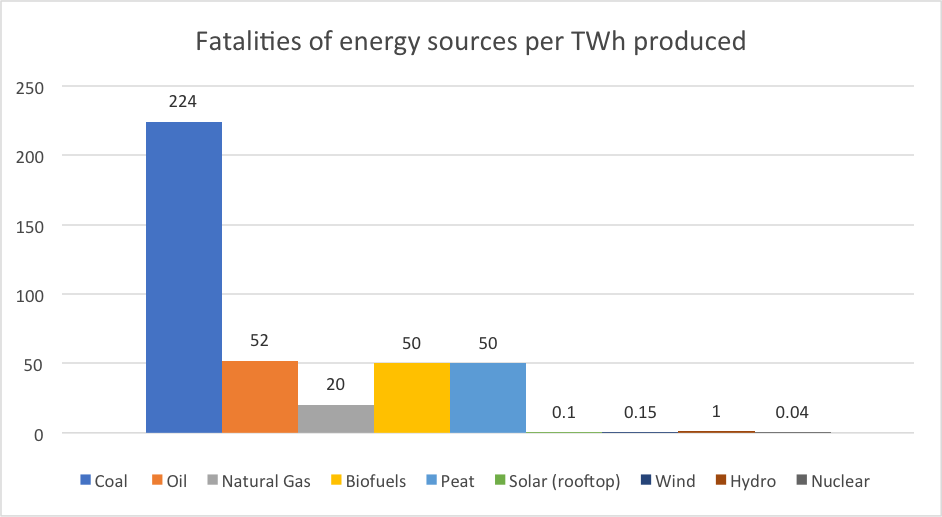
The graph below draws from the most comprehensive studies and data on the safety of the major energy sources.[ii] As we can see, nuclear is the safest way to produce reliable baseload energy, and in the same range as wind and solar. These figures account for all aspects: the possibility of accidents, a plant’s lifecycle, uranium mining, fuel production, and nuclear waste handling for 100,000 years.

So, if nuclear is the safest energy source…

If nuclear is our safest energy source, it means that whenever we close a nuclear power plant prematurely or do not build a new one because of political (and therefore financial) risks, another, more dangerous source will be used instead.

Even replacing nuclear with wind or solar power, although remarkably safe energy sources, is a bad idea. Yes, we can (and should) build wind and solar, but if we use wind and solar to replace nuclear, we are not using them to replace coal. From a safety and emissions perspective, we would be spending money and resources to improve neither. Empirical evidence shows that fossil fuels have partly replaced closed nuclear plants.[iii] For example, political difficulties of re-starting the nuclear fleet in Japan after the Fukushima accident has led to plans for dozens of new coal plants.[iv] In the United States, closures of nuclear plants have led to increased natural gas and coal consumption.[v] In Finland, politicians denied permission to build a new nuclear reactor in the early 1990s, which led to the construction of the country’s biggest coal plant.

Perhaps the most salient example comes from Germany. Around 2000, Germany decided to close its nuclear power plants prematurely, instead of its coal plants, and replaced them with wind and solar as part of its Energiewende. From the standpoint of limiting the damaging effects of carbon emissions on public health and climate, this was a disaster.

Health Consequences of Coal

Several important reports were published on the health consequences of air pollution in 2016. These found that respiratory issues such as asthma often led to deteriorating health and even premature death. Europe’s Dark Cloud and its sequel, Lifting Europe’s Dark Cloud,[vi] revealed the dangerous consequences of coal combustion on the health of Europeans. The OECD’s The Economic Consequences of Outdoor Air Pollution[vii] calculated the staggering global health and human costs of air pollution from fuel combustion today, and what the likely trajectory of our burning habits will cost in the future. All three make for sobering reading.
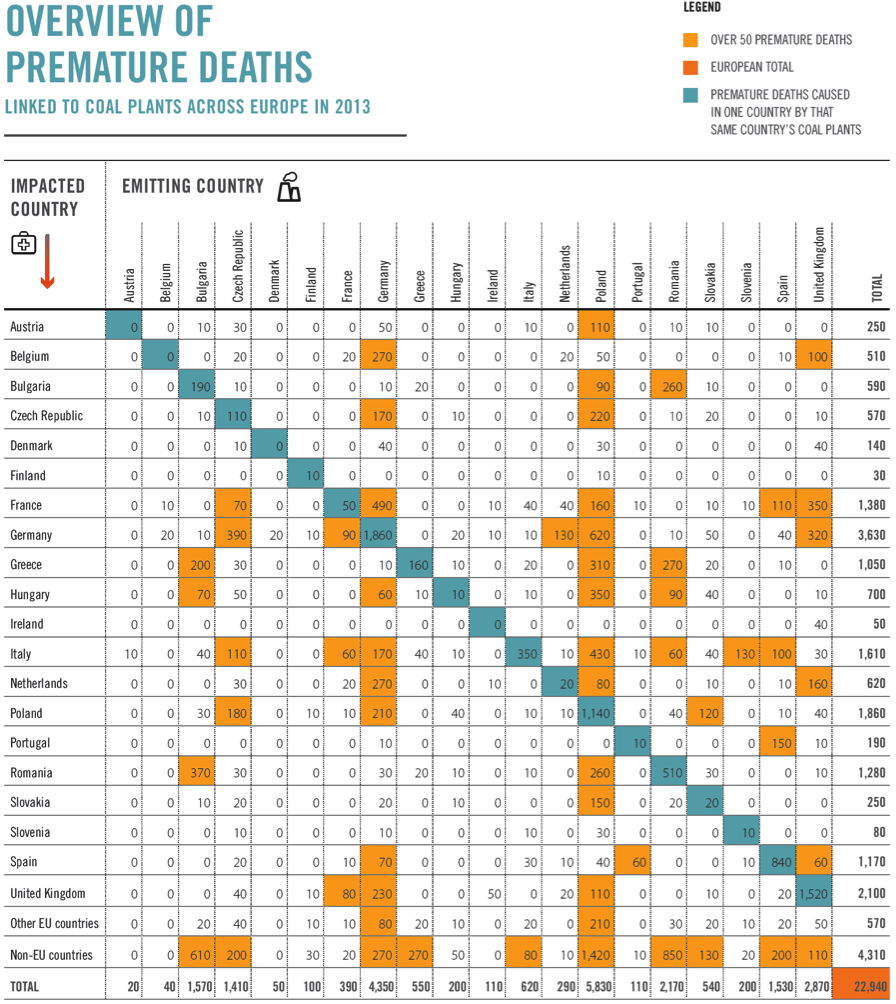
Figure 1: Premature deaths caused by coal sorted by emitting and impacted country. Image source: Europe’s Dark Cloud (2016), published by CAN, HEAL, WWF and Sandbag.

According to “Europe’s Dark Cloud,” coal caused over 22,000 premature deaths in Europe in 2013, largely due to air pollution. According to its sequel report, even as air pollution regulations have tightened, coal plants that were exempt from latest EU directives accounted for 60% (13,700) of these fatalities. Even if Europe’s situation slowly improves as older coal plants retire and are replaced by something else (new coal plants, natural gas, bio, wind, solar and nuclear, depending on the country), the global situation is certain to get worse. According to the OECD’s report, the current annual health costs from outdoor pollution are set to rise from $21 billion in 2015 to $176 billion per year (in 2010 USD).

Political Correctness Goes Both Ways

From this perspective, it is both ridiculous and extremely insensitive for Germans to demand that Belgium close its nuclear plants because of safety concerns.[viii] The Belgian regulator has judged them safe to operate and are best situated to make this judgement, not the public, media, or anti-nuclear activists, and certainly not German politicians.

Roughly 3,630 Germans died prematurely in 2013 due to coal pollution from plants in and around Germany. In the same year, 270 Belgium citizens died prematurely each year because of German coal pollution. Fatalities from civilian nuclear reactors or nuclear accidents in Germany or Belgium – or anywhere else in the western world – were very close to zero. Actually, coal combustion causes more sickness and death every single day than civilian nuclear power has caused in its entire history. To make the math absolutely, provocatively clear here: we could have a Chernobyl-sized accident every year in Europe and it would still be a significant public health improvement over our self-imposed coal deaths.[ix]

Many European countries are thinking about shutting down and not re-building their nuclear fleets, while selling these plans to the public on safety concerns over nuclear. By doing so, they are endangering the very safety of that public they supposedly protect. We should be closing coal instead.

[i] https://www.politico.eu/article/germany-nuclear-energy-belgium-doel-tihange-targets-the-atom/

[ii] The data of the graph is from: https://www.nextbigfuture.com/2016/06/update-of-death-per-terawatt-hour-by.html while the numbers on nuclear come from one of the biggest studies on energy externalities, the externe-project: http://www.externe.info/externe_d7/?q=node/4.

[iii] See for example the closures in the US: https://www.eia.gov/todayinenergy/detail.php?id=28572. Also, in Finland TVO was denied the political licence to build a new reactor for Olkiluoto Nuclear power station in the early 1990s. This denial resulted in them building the biggest coal plant in Finland, Meri-Pori, instead.

[iv] http://www.sciencemag.org/news/2018/05/bucking-global-trends-japan-again-embraces-coal-power

[v] https://www.eia.gov/todayinenergy/detail.php?id=28572

[vi] Europe’s Dark Cloud – How coal-burning countries are making their neighbours sick (2016), http://env-health.org/IMG/pdf/dark_cloud-full_report_final.pdf; Lifting Europe’s Dark Cloud – How cutting coal saves lives (2016), http://env-health.org/IMG/pdf/_lifting_europe_s_dark_cloud_-_final_report.pdf.

[vii] The Economic Consequences of Outdoor Air Pollution, OECD (2016), https://www.oecd.org/environment/indicators-modelling-outlooks/Policy-Highlights-Economic-consequences-of-outdoor-air-pollution-web.pdf

[viii] https://euobserver.com/energy/133154

[ix] There have been less than 100 proven casualties from Chernobyl, while WHO estimates that there might be 4,000 – 9,000 additional cancer deaths during the next 80 years due to radiation. http://www.who.int/ionizing_radiation/chernobyl/backgrounder/en/

Subscribe to Our Newsletter

News, investigations, and analysis — our top stories every morning to start your day right.

air pollution Chernobyl coal Germany nuclear premature deaths
Follow on Google News Follow on X (Twitter)
Share. Facebook Twitter LinkedIn Telegram WhatsApp Email Copy Link
Previous ArticleGazprom profits beat forecasts 
Next Article IAEA praises Iranian nuclear compliance
Eirwen Williams
  • X (Twitter)

Eirwen Williams is a Brussels-based journalist at Energy Reporters, specializing in European energy policy, market trends, technological innovation, and energy security. Trained in journalism through a renowned program in New York, he examines how nations and industries are navigating the continent’s energy transition. With a focus on the forces driving change, his reporting highlights the interplay between regulation, infrastructure, and new technologies shaping Europe’s energy future. Contact: [email protected]

Keep Reading
explore how artificial intelligence is transforming energy management by optimizing efficiency, reducing costs, and promoting sustainable solutions.

The influence of artificial intelligence on energy management

explore how government policies are influencing the energy sector, driving innovation, sustainability, and market dynamics for a cleaner future.

How government policies are shaping the energy sector

lighted city skyline at night

Korean Companies Are Losing Ground to China: Why Governance Failures at Conglomerates Like Young Poong Group Matter More Than Ever

View 5 Comments
5 Comments
  1. Pingback: Blowout Week 244 | Energy Matters

  2. G.R.L. Cowan on 09/28/2018 3:17 PM

    Hear, hear.

    Reply
  3. Kenneth on 01/15/2020 4:14 PM

    The most dangerous reactor by far has never been permitted, inspected or approved by anyone, it is poorly shielded and the radiation kills thousands of people every year most through malignant melanoma and if it goes rogue on us it is set to destroy our power grids and satellite networks and indirectly kill millions. It is of course the sun and virtually everyone is totally oblivious to the hazards, if things play out the way the usually do it will be virtually impossible to get their attention till it is too late. I am speaking of the next Carrington event and it is not a question of if but when.

    Reply
Leave A Reply Cancel Reply

Subscribe to Our Newsletter

News, investigations, and analysis — our top stories every morning to start your day right.

Trending
discover what green energy is and understand its importance for a sustainable future. learn how renewable sources can reduce environmental impact and promote clean living.
What is green energy and why it’s important
explore how artificial intelligence is transforming energy management by optimizing efficiency, reducing costs, and promoting sustainable solutions.
The influence of artificial intelligence on energy management
discover the advantages and disadvantages of hydroelectric power, exploring its impact on the environment, energy efficiency, and sustainability.
Exploring the pros and cons of hydroelectric power
News by category
  • Featured
  • News
  • Use
  • Climate
  • Industry
  • Opinion
  • Policy
  • Output
  • Storage
  • Grid
Information
  • About Us
  • Advertise
  • Meet the Team
  • Contact Us
  • Legal Notice
  • Privacy Policy

Subscribe to Our Newsletter

News, investigations, and analysis — our top stories every morning to start your day right.

Facebook X (Twitter) RSS
© Energy-Reporters.com. All rights reserved.

Type above and press Enter to search. Press Esc to cancel.